Showing posts with label tomato. Show all posts

Monday, June 2, 2014

Oh Kale... (and garden updates)

Just a summer update on the status of my garden, which has chugged away this spring and summer with surprising alacrity. After last year's massive disappointment™, the Georgia sun has smiled upon us, and given us just enough growing days both to maximize the early lettuce crop and get the tomatoes off to a running start.

Among the biggest hits this summer are sugar snap peas. Sweet and punchy, and so delicious that my seven year old has devoured them almost as fast as they have grown up. More than once we were able to send them in her lunch. Given how well these delicate climbing vines like the cold weather, I want to take a run at fall growing in greater numbers.

Winterbor in summer
Kale has been resilient and prolific and as tender as this thick green leaf can get. We planted two varieties. The superior plant was Nero di Toscana, an Italian heirloom that produces almost beveled leaves, long and flat and dark green. The other is Winterbor Kale, a hybrid that is, surprise of surprises, winter-hardy.

The Toscana leaf does have a superior taste, no question. This might be why the bugs like it. At least, I presume the leaves have been somewhat mauled by the bugs. While that does not affect flavor (there is plenty of leaf to go around), it does lessen the aesthetic effect. Effectively. But I might try more marigolds with this next year.

The Winterbor leaf is actually the prettier of the two. It produces a curled blue-green leaf that almost shimmers in the light. And while the Toscana leaf has a superior taste, both in depth and texture, the Winterbor is formidable in its own right. If one likes Kale, one loves this Kale. At least from my garden.

I have no idea what is to become of the Kale as summer grinds on. I don't know if it will return or if I must replant it. We shall see. If I do, then I must take care to listen to the instructions and plant 12 to 24 inches apart. My plants are too crowded at present, and it stunts leaf production.

Cobbler, anyone?
The rest of the garden soldiers on. The tomatoes are popping up quickly and flowering and fruiting. I'm guessing another 30 days to some good production.

The blueberries are looking taut. And tasty. Let us pray. The strawberries have already produced and will continue to produce. They are sweet and soft.

cuke in the cage
It's a good garden year. The cucumbers are up and running. The broccoli has been tender. The radishes peppery.


Tuesday, September 10, 2013

Some new plantings...

So, a fall garden. Long desired. Finally planted. I put down radishes in a small patch next to the lemon balm. Along the walkway I planted arugula and zanzabar spinach. Or some spinach varietal. Can't recall now, and perhaps it does not matter--the seeds came from a neighborhood friend and I'm not entirely certain she knew what they were. Swiss chard went in the second row in Maia's plot.

Volunteer tomato plants are now fruiting much more bountifully than my original transplants. Of course it is late for tomatoes, and I am in bad need of some fertilizer. I am committed to the fish emulsion, so I must go get it. The fall garden, at present, has the potential to outstrip my summer garden. Already I'm seeing what I believe are arugula sprouts. Ha! Or perhaps spinach. I cannot recall which I planted closer to the door. Too little time to record such things. But hope springs eternal. If I can grow a decent fall garden, it will bode well for a new year.

Now to write that book I promised my editor...

Monday, August 26, 2013

The case of the missing tomatoes

The wet weather has claimed my tomatoes, I fear. So too did an ill advised decision to try and train the tomato vines to a single vine. My more successful plants were allowed to bush out somewhat. Also, I had a reversal of fortune. The front planter put up an admirable show, but did not produce near the level of quality fruit as last year. By contrast, the tomato in Maia's corner has produced succulent cherries, tart and sweet with a fair pop. Last year, that plot was near dead. My amending of the soil clearly had the intended impact.

I fertilized the garden two days ago. 2 oz. on everything. Last of the fertilizer.

Monday, July 15, 2013

The Curse of Temperance

Temperance, at least in its non-ironic form, would seem a virtue. Certainly for weather, where temperate climates attract swarms of humans. I certainly pine for temperate weather when the hottest and coldest days are upon us. But this summer, in the middle of July, I find myself wishing it were hotter, more humid, sunnier. I would like to sweat my body weight every day. I want to feel like a salty heap.

But why? Why? After all, am I not enjoying the morning walks with my dog, feeling chilly in a t-shirt? Am I not enjoying seeing 70 degrees on the coke sign thermometer outside my downtown office? Am I not pleasantly surprised when I wear a hoodie all the way home without realizing it? (That one does require a modicum of explanation--my office is sometimes air conditioned to sub-arctic levels, and I put the hoodie on in my office. Then I went home, and realized, half way, that it was still on.) So why? Because my tomatoes are not coming along. We are in mid-July, and I've had only a few beefsteaks and a few handfuls of cherries. The vines are not fruiting. The fruits are not growing. By now in any given year, my diet consists largely of tomatoes. Tomato sandwiches, tomato salads, tomato just because. I now fear that this will be a lost year.

The peppers are slow to ripen too. I have only two that have begun to ripen past green. My major discovery this year was that pepper plant branches have to be supported, lest the heavy fruit weigh down and rip them off. And i did have them staked--just not properly.

The hot weather will come, no doubt. Until then, we slog along in wet and cool weather. My heart goes out for the poor farmers who have lost their crops. I know my little garden has suffered through, of all things, mild temperatures and lots of rain.


Thursday, July 11, 2013

Fertilizing the garden

Fertilized the garden. Yesterday. It has been tough to get to this because it has been so wet. Everything is coming along fine, although I lost a branch on a pepper plant. Too heavy, I s'pose. The squash borer is slowly threatening my summer squash plant, although I have now gotten at least six squash from it and more are coming. We've made one casserole and grilled up the rest. So I can't really complain.

You can kind of see one pepper that is ripening here
The tomatoes continue to sit, and the fruit is not ripening. This is the coldest, wettest summer I've seen since I moved to Atlanta. Whoever thought I would complain about rain! The upside is that I haven't turned a hose on in weeks.


The sunflower my daughter grew. It stands ten feet tall now

Lettuce

Friday, June 14, 2013

the gin, the tonic, and the garden

I've been researching gin and tonics this week to try and figure out the best way of using my tonic water. It's been arduous. But then again, I suffer for my art.

There are two versions of the gin and tonic that I make. The first is The Quencher, and it works something like this:

1 part gin
1 part tonic syrup
5 parts club soda

If I do this with 1 1/2 oz. parts, then I'm looking at a very tall drink--nearly 12 oz. of fluid on top of a whale's share of ice. I don't bother garnishing this, but it'll take a squeeze or two of lime or lemon, should one want. The Quencher is perfect for touring my extensive gardens, especially when the black krim is beginning to fruit.
The Black Krim shows progress


Velvet Underground?
The second version is The Standard:

2 parts gin
1 part tonic syrup
4 parts club soda

This makes a standard gin and tonic--as close as I can get to what it tastes like when I use Schwepps, Q, Fever Tree, or what have you. In short, I believe this is the correct recipe to create a gin and tonic that you might order at a serious cocktail bar. And The Standard is not just a modified Quencher. Parts should be measured with a 1/2 or 3/4 oz. jigger and it should be served in a traditional highball glass. To order a double is, inappropriate. Garnish is not necessary, but lemon peel is nice. So too is this cucumber, with Hendricks gin.

The third version is The Bitter Pill:

2 parts gin
1 part tonic syrup
1 part club soda

Mix ingredients in a shaker, add ice and shake vigorously five or six times. Strain over a highball glass packed with ice. You can also "layer" the drink by shaking it without club soda, pouring over ice in a highball glass and then adding the club soda.
The cucumber in perspective

Saturday, June 8, 2013

The Rose and the Black Krim

I broke down and bought some 3 in 1 and treated my knockout roses, miniature roses, and Jethro Tull. 3 in 1 is this ugly milky concentrate that does not mix well with water. So I really don't know if I got enough into the soil, or if it all went into the last plant that I treated. Which is good news for the Jethro Tull, and the knockout roses closest to Doug's house.

The Black Krim is starting to flower. Given that I'm not allowing my tomato plants to vine out like I did last year, I'm anxious about fruit production, especially after the squirrel's share is calculated.

the Krim flowereth

Saturday, June 1, 2013

The Whoppers Are coming in

Fertilized the garden today. 2 gallons of fertilizer went on the blueberries and the tomato plants. Also fertilized the begonias and the summer squash.

The summer squash is beginning to come in. The plant looks healthy. My lettuce is producing beautifully. Enjoy it while it lasts--my best is that two weeks more is about as much lettuce as I will get.


Tomato report. The transplants all did quite well. Only the Juliette cherries did not survive. I'm not sure what happened, except that the stalk broke at its base. Given that the plant was not top heavy, I have no idea what precipitated this. I staked the plant immediately, but it is worth pointing out that none of the other plants required staking at this point. The leaves have all since wilted, but the stalk still appears to be alive. I'm monitoring it daily.

The Black Cherries were the first to fruit. That planter has always produced beautiful tomato plants, with thick, Jack-and-the-beanstalk-style trunks and multiple vines that I train up the light pole (and whatever plant grows around it).

The Whoppers and the Beefy Big Boy plants are beginning to bear fruit. They are quite pretty, and my guess is that we are three weeks from potential harvest here.

Planting dilemma. The lettuce will doubtlessly bolt sometime in June. I have to decide whether to let the space remain fallow until the winter garden is planted, or try and bring up something else in the meantime.

Monday, April 29, 2013

Finishing the Rows

Today I laid out the rest of Maia's plot.

Juliet Tomatoes and Max's Wild Cherries.

Chives (still flowering from last year); Matilda butter lettuce and red arrowhead lettuce; gentry summer squash

Diva -- Jade -- Diva cucumbers -- Matilda butter lettuce -- red arrowhead lettuce -- tomatillo.

I mixed black cow and my homemade compost into the rows and topped them with Miracle Grow Garden Soil. The soil quality doesn't look perfect, so we will see. I added some blood meal along the top, fertilized it all right off the bat and mulched the whole thing. Now I will let benign neglect bring the fruits in.

Sunday, April 28, 2013

The Black Krim and the Morado

I am a fan of the black tomato. The prize of my 2012 garden were my two cherokee purple plants. The yield was moderate to large, and the fruit was dark and succulent. My predilection for strong flavors probably pushes me in the direction of dark tomatoes, and as such the cherokee purple was a wonderful introduction.

This year I have planted two varieties of black tomatoes, both heirlooms from the east.

The Black Krim comes from the Isle of Krim on the Crimean peninsula. The dark red mahogany beefsteak tomato should bring big yields and a slightly salty taste.

The Morado tomato is quite similar, but the seed is Spanish in origin. The climate conditions of its initial growth seem to favor Atlanta, as it likes both heat and elevation. I'm hoping it will be a big producer in the years to come.

The advantage this year is that I can compare the fruit of these two black tomatoes to see if there is any substantial (or subtle!) difference. And i am continuing my pattern of planting two black tomato plants a year. Sadly missing this year are yellow and orange varietals, but alas! I went light on reds last year,  We'll see how the Whopper and Rose tomatoes turn out.

Garden plantings, 2013

The tomatoes are in! For reasons well beyond my control, I was unable to plant early this year, which had been my hope. It is my dream to have early June tomatoes, but alas, not this year.

This year I bought tomatoes from GardenHood, which stocked tomato seedings from a Decatur farm. I settled on the following:

Black Krim
Beefy Big Boy
Yellow BrandywineWhopper
Morado
Rose

In the front planter, I put in Black Cherry.

More on the

I am also adding a bed to the front, and I began with lemongrass. I will add creeping perennials next, and probably put one more row in behind it, hopefully stocked with radishes, carrots, lettuces, et al.

Tomatillos are the first plant in Maia's plot.

That's all for planting--technically done on Saturday, one day before this post.


Tuesday, March 5, 2013

Can we be vegan before six?

Mark Bittman cut a deal with his doctor some six years ago, who advised him to give up meat. He'd turn vegan, he said, but every night at six (when the moon was just right) he'd transform into a carnivorous beast, sating his appetite with whatever flesh he chose to pounce upon that night.

Apparently, the diet worked, and he has a new book coming out about it, which I might well want to get at some point. But the point of this rambling post is to note that I made the same bargain a couple of years ago. While not vegan, I have been solidly vegetarian until 6 pm every day without fail. Of course, I exclude from this the occasional breakfast meat or egg (once every few weekends) and the once every two months or so pilgrimage to farmburger for lunch. (Speaking of which, I am overdue...) But day in and day out, my lunches consist of a mass of fruits and vegetables.

Such a diet is not always comfortable. Raw vegetables don't sit well with me, and as such I tend to avoid them--especially raw onions, broccoli, and cauliflower. When the tomatoes are ripe in the summer, I make endless tomato pita pockets, dressed with Spectrum's omega-3 mayonnaise and clover/alfalfa/broccoli sprouts. In fact, I eat so many tomatoes in the summer that I'm fairly certain some rare blood disease solely attributable to massive tomato consumption is my future. For this, I blame 4th & Swift, the restaurant that introduced me to Cherokee Purple tomatoes (and still probably the best tomato salad preparation I have ever had). But come October, the last of the tomatoes are off the vine and come November the last of them are ripening. Even green tomatoes at this point end up somewhat mealy in texture and grumpy in flavor. Finding another lunch staple has been, to say the least, difficult.
lunchy salads

But no longer. A trip to Empire State South changed this when I discovered the grain salad. I have always avoided grains on the idea that they were sugar and thus to be avoided. But now that I have turned away from most super-refined sugars, grains have proved a great way to fill the void. Lunch is now a farro and arugula salad, usually with sliced green olives and Parmesan cheese, dressed with a red wine vinaigrette. I add an apple and a banana, or sometimes blueberries, or any measure of the three in order to make it a proper lunch.
Farro, Steel Cut Oats, and Quinoa
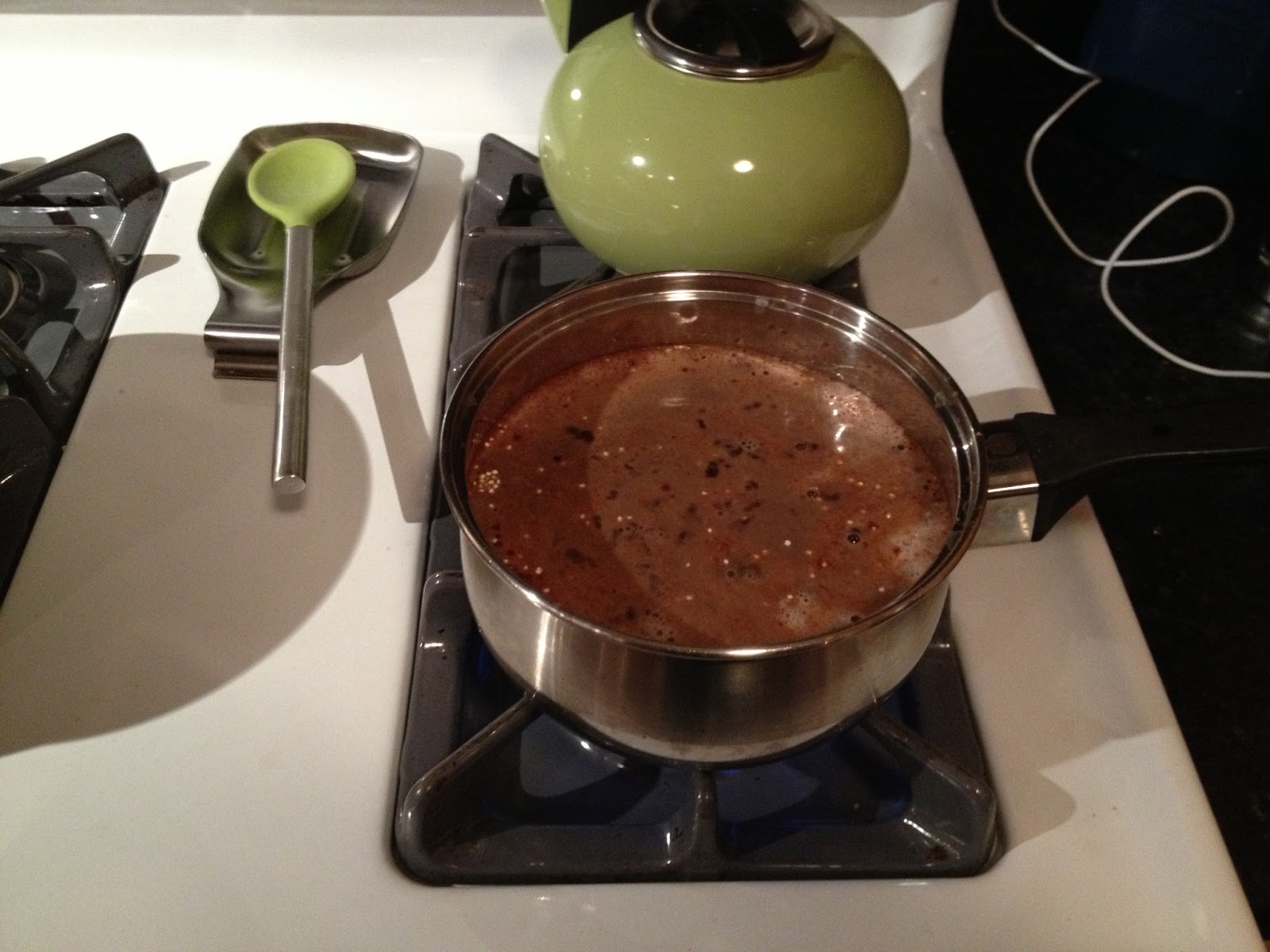
Making oatmeal. Only this one had quinoa in it. Not to be repeated


Breakfast, which I once skipped on a regular basis, is now almost always steel cut oats loaded with fresh blueberries or strawberries (if I can find any), walnuts, raisins, and/or dried apricots. The grain cereal eaten at 6:45 holds me until 11 or 12, depending on when I eat lunch. And on the weekends, I use the oatmeal to make pancakes for Maia. That makes the pancakes *almost* justifiable.

My typical oat preparation is simple and rewarding. First, I start the kettle. Then I toast one cup of dry oats in a tablespoon of butter. Once they are fragrant, but before they burn, I add three and a half cups of hot water and bring to a boil. This usually takes not time at all. Then I cover the oats and remove them from heat and let them sit overnight. By morning, they are ready to go. This preparation has never failed me.

Not all of my experiences have been good. A tantalizing article in Bon Apetit asked the question "did you think Quinoa was just for savory salads?" Why yes, I thought, I did. But the article recommended an ambitious hot cereal recipe calling for half oats and half quinoa, as well as raisins and cinnamon and cardamom in the pot. As above, the recipe recommended letting the porridge sit overnight after bringing to a boil. For serving, it recommended any number of nuts and fruits and--and this should have given me pause--a drizzle of maple syrup.

By the end, the article had answered its own question: "Yes, Quinoa is just for savory salads." Never again.

Monday, January 7, 2013

Garden Recap 2012

In all, it was a successful gardening year, although it left me realizing just how much potential went unfulfilled. Given that my approach is still experimental and amateurish, this is not a source of significant anxiety, but it did leave me wanting more.

SUCCESSES:

The Tomato Row. Instead of clustering plants, I put them in one of the front rows, and this allowed for a continual source of varietals. We feasted on Cherokee Purples, Sunny Boys, and Jaune Flamees all summer. The determinate Orange Blossom variety gave us early tomatoes, and the Mortgage Lifters took the longest to mature. I will plant a couple more plants this next year, but the basic shape has now taken hold.

Peppers. I planted bell peppers that did beautifully, although I needed more plants. I really need a row of about six to make it work properly. Hot peppers seem to grow more fruitfully, although this year my jalepeno plant did not take.

Herbs. I got excellent use of my peppermint, spearmint (second year), oregano (second year), thyme, sage, cilantro, parsley, and lemonbalm. Chives were particularly helpful. More herb bushes in general need to be planted. As does garlic.

FAILURES:

My silver edge thyme was pretty, but useless as an herb.

My sweet olive tomatoes did not produce. I should probably replenish the soil in the spot and plant two grapes there, or perhaps a roma plant along with a grape plant.

Romas, actually, are a necessity I need to follow up on. We are on the verge of needing to make our own tomato sauce for use in all kinds of dishes. I should probably plant two roma plants this year, one in each of the "planters" to go along with the grape and cherry varieties. OR, I should consider committing several spots to determinate romas and then pulling the plants after they bloom and replanting a second summer crop.

No beans. I have all the capability to plant pole beans. I should do it. We eat green beans all the time. Twice a week on average.

Variety. On this last point, it would be nice to have a little more variety from the garden. More beans, more lettuce. In fact, I have never successfully planted lettuce. Time to start afresh this spring.

Thursday, August 2, 2012

An ill omen indeed

This morning I fertilized the tomato plants, spreading nearly two gallons over all of them. This represents the heaviest fertilizing I have completed to date. But given that the soil must be weakening and the plants are getting ready to bear fruit, I was anxious to accelerate the fertilizing schedule and increase its volume.

I fertilized at about eight thirty this morning. I should have done it earlier to avoid even more evaporation. When I left the house at nine, the smell of fish emulsion was still heavy in the moist morning air. Will water tomorrow to counteract our droughty conditions.

Also, I saw this sign on my way to work today. I'm still puzzling over it. In relation to my garden, this might be an omen. My second crop of tomatoes may disappoint. Or perhaps the lettuce I plan to plant next weekend will not take. Maybe the squirrels will tighten their racket and take a larger share. I feel oddly concerned.

Wednesday, August 1, 2012

garden update

The Sunny Boy plant, rolled over
 I have posted several times about the out of control tomato plants, and have now come to grips with the fact that all of this really is my fault. As a horticulturalist, I am a failure at best. My only consolation is that the mammoth fruit the plants produced have kept me and my neighbors and my friends happily munching on salad caprese, BLTs, and just plain tomatoes ever since late June. With the current crop starting to vine ripen, the party might keep going until November. So I don't feel too bad about failure in this case. But, time to reflect.
The squirrel's share at mid-center

This Cherokee Purple is the size of two fists. I shall name it "two fists"
  • Plant two determinate vines, one as early as possible and another one month later. Put them in cages and keep them away from the other plants. My orange blossom tomatoes were the first to arrive and were delicious. I would have loved to have them about two weeks earlier than they did arrive, and would love another batch right about now. The determinate vines produce a huge bunch of fruit all at once. They are great for gift baskets, and they would enable me to keep a more steady crop going.
Barbarella out on the town
  •  Stake the vines, dammit. Tomato cages are useless (except for the bushier determinate vines). I need a real stake, not the fake bamboo junk I was hustled into. I need at least six feet of stake above ground to house these monster plants. 
  • Once staked, trim so that the plant grows along the stake. This involves pulling off the suckers and making sure the plant doesn't veer off in one direction or the other. 
  • I know the above two points are elementary. I had read them before I planted. But last year I survived on cages, so it was stubbornness rather than stupidity that led me to try and cage these beasts.
Bell's early orange, not quite early, but orange-y
  • This year I planted one cherry (Juane Flamee), one grape (sweet olive), one determinate (Orange Blossom), and four beefsteak style plants (two Cherokee Purples; Mortgage Lifter; Sunny Boy). 
  • Next year plant at least two cherry/grape plants, two determinate plants, and at least five other heirloom varieties. Cherokee Purple is a must. 
  • Maybe avoid the eggplant next year. Although it is beautiful.
  • Need. more. peppers. Hot and sweet. A full row next year. These plants could take the cages.

Sunday, July 29, 2012

fertilizer

boring post--just to record that I fertilized the rest of the garden today: peppers, eggplant, roses, etc. Everything I missed last week.

The last Cherokee Purple of the first harvest are ripening on the vine. I've nicknamed one of them Baby Jesus. It's fabulous.

Sunday, July 22, 2012

fertilized the out-of-control tomato plants

Yesterday I fertilized the tomato plants. There was much rejoicing. I also fertilized the peppers and the eggplant, yada yada yada.

I am not sure what to do with the tomato plants. They have all grown out of control. Top heavy, loaded with big fruit, gnarled and angry in some cases, distressingly tall in others. I've staked them all now, given that they destroyed the cages that I initially placed them in.

I don't know what to do. I want tomatoes to continue through October, but I am at a loss as to how to control these crazy vines. The harvest so far has been brilliant, so may it continue.
This is a huge platter, so imagine these tomatoes as fist to two-fist size...

Friday, June 22, 2012

garden up!

The flowers on the Barbarella eggplant first bloom ...
... then swallow a grapefruit

Look ma, no suckers!


All in all not bad
Pollinators in a short bed


Did a few things today worth talking about.

1) I've begun really trimming off the suckers, especially from the bottom of the plant. This helps air circulation (apparently) and more importantly discourages bugs.

2) For what it's worth, the suckers on my Orange Blossom vine grew fruit. But now those low arms are hanging on the ground. And I found ants all over my Orange Blossoms. On one in particular. I knocked them off, but no telling what this means. I propped up both the lower branches to get them off the ground.

3) I planted two more perennials in my mailbox plot, both of which are supposed to fill out the bed and provide more flowers to attract pollinators. In addition, I moved another cutting of golden pineapple sage to the front, making three in all. They really do thrive, and should send up beautiful red flowers in the fall to attract the pollinators.

first fruit

The tomatoes are beginning to produce. The first large tomato was, to no one's surprise, the Orange Blossom. Also in the basket are red sweet olives, yellow Juane Flamees, and a cucumber. I'm getting four or five cucumbers a day.

Tuesday, June 19, 2012

tomato update

My tomatoes appear to be on their way to high yields and at least fist sized fruit. They are ripening at different stages, which more or less tracks with their initial growth in the soil.

The Mortgage Lifters have been slow growing and are only now producing small fruit. I couldn't catch the beauty of these early tomatoes on my phone, which in essence refuses to focus on the foreground fruit. It is ribbed and elliptical.

The Cherokee Purples are both growing at about the same speed. They flank the Sunny Boy plant, and sometimes appear rather dwarfed by it, but the tomatoes are of great size and shape. Many are bursting through their skins, leaving holes in part of them.

The Sunny Boy has the thickest stalk of anything outside the Jaune Flamee, and it is producing some rather pretty fruit in the ribbed style of the Mortgage Lifter.

The Orange Blossom tomatoes were the fastest to rise, the first to bloom, and now sport the biggest fruit.

Mortgage Lifters Popping

Cherokee Purple #1

Sunny Boy

Cherokee Purple #2

Orange Blossom